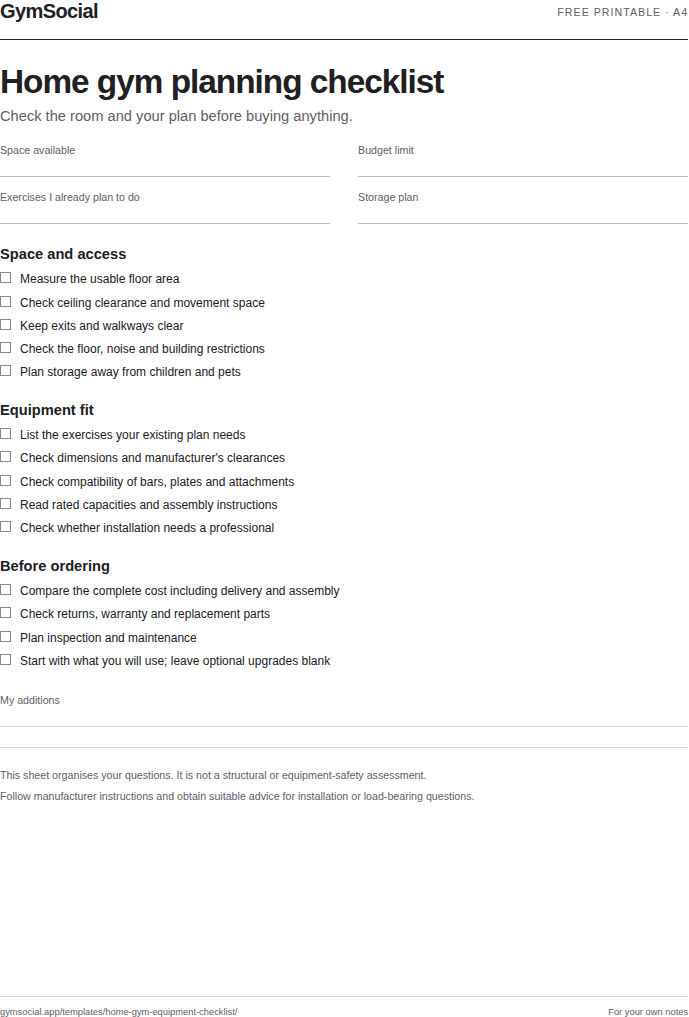
This home-gym checklist helps you organise questions before ordering equipment. It starts with usable space, storage and your existing training plan, then covers compatibility, delivery and maintenance.
It does not recommend a shopping basket or certify that a room can support a particular load. Use it to record the information you need from manufacturers, your building rules and suitable professionals.
Measure the usable space
Record floor area, ceiling clearance and the space needed to move around equipment. A product fitting into a room is different from having the clearance its manufacturer requires for use. Include doors, access routes and storage in the plan, rather than measuring only the central rectangle of the room.
Note floor, noise and building restrictions that you need to investigate. A checklist cannot assess a structure or approve an installation. Keep exits and walkways clear, and plan where equipment will be stored away from children and pets when it is not in use.
Match equipment to a plan you already have
List the exercises or activities you intend to perform before listing products. That gives each proposed purchase a purpose. Mark what you already own and what an existing facility provides. Leaving an optional item blank is often more informative than treating every category as essential.
Check dimensions, rated capacities, assembly requirements and compatibility of bars, plates or attachments. Similar-looking fittings are not proof of compatibility. Use the manufacturer’s documentation for the exact model and seek appropriate help when installation involves structural or electrical work.
Record the complete decision
Compare total cost, including delivery, assembly and any installation work. Keep return terms, warranty information and replacement-part availability alongside the model details. Retain the manual and record the model, serial number and purchase date. A lower headline price does not tell you whether an item suits your space or how it can be maintained.
The printable includes room for inspection and maintenance reminders. Follow the product instructions rather than inventing a universal schedule. Revisit the checklist when your room or training needs change; it is a record of your questions and decisions, not an invitation to keep adding equipment.
Common questions
Does this tell me what my floor can support?
No. Load-bearing and installation questions need suitable professional advice and the exact equipment specifications.
Does it include product recommendations?
No. It helps you compare requirements and document your own choices without prescribing brands or a budget.